
Dialing Guilford County Phone Codes
Guilford County is in the 336/743 overlay complex, so the daily dialing rule is built around the full 10-digit number. That means the area code is part of the local call format inside Greensboro, High Point, Jamestown, Summerfield, Oak Ridge, Stokesdale, Pleasant Garden, Gibsonville-area exchanges, McLeansville, Sedalia, and nearby county communities. The rule does not make each local call a toll call. It gives the network enough digits to distinguish a 336 number from a 743 number when both phone codes can serve the same place.
The practical dial flow is short, but it matters. For a local Guilford County call, dial the area code plus the seven-digit number. For a domestic long-distance call, some landline or VoIP plans may still require 1 before the 10-digit number. For an international call from a landline, use the international access code before the destination country code. On a mobile phone, storing numbers with the plus sign and country code is often the most portable format.
- Local Guilford County call: dial area code plus seven digits.
- Domestic toll call if required by the carrier: dial 1 plus area code plus seven digits.
- Call abroad from a landline: dial 011, then the country code, then the destination number.
- Call Guilford County from abroad: dial the caller's exit code, then 1, then the 10-digit local number.
Note: Permissive 10-digit dialing began in October 2015, and mandatory 10-digit local dialing began April 23, 2016.
Guilford County N11 Phone Codes
N11 codes are three-digit service codes reserved for broad public or network functions. They are not local area codes, and they are not full phone numbers. In Guilford County, the most important distinction is that some N11 codes route to a public service, while others depend on the caller's carrier or device. The NANPA abbreviated-code reference is the numbering-plan source for these short codes, while local and state agencies define how many of them are used in North Carolina.
| N11 Code | Use in Guilford County and North Carolina | Local Caveat |
|---|---|---|
| 211 | Community information and referral through NC 211, including health and human-service referrals. | NC 211 also publishes 1-888-892-1162 for access outside the short code. |
| 311 | Non-emergency local-government services where a city has implemented the short code. | Greensboro's captured source routes services through 336-373-CITY / 336-373-2489; countywide 311 was not confirmed. |
| 411 | Directory assistance. | Availability and charges vary by carrier. |
| 511 | Traffic and travel information. | North Carolina travelers should use NCDOT and DriveNC resources for current road details. |
| 611 | Telephone repair or customer service. | The call routes to the caller's own phone company. |
| 711 | Telecommunications Relay Service for TTY and relay users. | Relay access is not a county department line. |
| 811 | Call Before You Dig excavation notice service. | NC811 handles locate requests before digging. |
| 911 | Emergency police, fire, and EMS response. | Immediate emergencies in the Greensboro/Guilford public-safety environment route through emergency communications. |
| 988 | Suicide and Crisis Lifeline by call, text, or chat. | Use for crisis support, not routine directory help. |
The FCC also maintains a consumer reference for nationally assigned three-digit N11 numbers. For local use, Greensboro service requests and county emergency services should still be checked through the relevant official local source, because an N11 code can coexist with a full published phone number.
Guilford County Star Phone Codes
Vertical service codes are the star codes used to control a feature on a phone line. They are different from N11 service codes because they act on the caller's own line or on the last call event. They are also more carrier-dependent. A code that works on a traditional landline may not work the same way on a wireless plan, a cable-phone service, an office PBX, or a VoIP app used by a Guilford County business.
| Star Code | Common Function | Important Limit |
|---|---|---|
| *57 | Call trace after a threatening or malicious call. | Carrier and law-enforcement steps vary. |
| *60 | Selective call block or call rejection. | Supported lists and setup prompts vary. |
| *67 | Block caller ID for the next call. | Wireless and VoIP behavior may differ. |
| *69 | Return the last incoming call. | May fail on blocked, private, or routed calls. |
| *70 | Disable call waiting for one call. | Most useful on traditional landline or PBX service. |
| *72 | Activate call forwarding. | The user normally enters the forward-to number after the code. |
| *73 | Cancel call forwarding. | Prompts depend on the carrier. |
| *77 | Turn on anonymous call rejection. | Traditional line feature, not universal. |
| *82 | Unblock caller ID for one call. | Useful only where per-call blocking is active. |
| *87 | Deactivate anonymous call rejection. | Carrier support varies. |
These phone codes are best treated as line-feature commands, not public agency contacts. If a Guilford County resident needs a verified public-safety, county, school, court, or utility number, the safer path is an official directory or service page rather than a star-code shortcut.
Calling Codes for Guilford County
The area code is the Numbering Plan Area, or NPA, at the front of a North American number. Guilford County's current local NPAs are 336 and 743. The older 336 code split from 910 in 1997, while 743 was later added as an overlay. Because an overlay places a new code on the same map, a 743 number can be assigned in the same Guilford County communities as a 336 number.
| Phone Code | Role | Guilford County Use |
|---|---|---|
| 336 | Historical and primary local area code. | Greensboro, High Point, Jamestown, Summerfield, Oak Ridge, Stokesdale, Pleasant Garden, Gibsonville-area numbers, and surrounding communities. |
| 743 | Overlay area code. | Same geography as 336; it does not identify a separate city or service type. |
| 910 | Relinquished parent code. | Guilford County was in 910 before 336 split from it; 910 is not a current local Guilford County area code. |
For the geographic story behind these codes, the Guilford County phone area codes reference gives the area-code split and overlay history in more depth. For dialing, the main point is simpler: both current area codes share the county's local calling environment, so a caller should not infer city, neighborhood, or rate center from the area code alone.
Toll-Free Phone Codes
Toll-free prefixes are phone codes too, but they are not local to Guilford County or North Carolina. The FCC explains in its toll-free number guide that these codes route billing to the called party rather than proving that the caller or business is nearby. A company with a toll-free line can serve Greensboro, High Point, and the rest of Guilford County without owning a local 336 or 743 number.
The active toll-free codes listed in the research are 800, 888, 877, 866, 855, 844, and 833. NANPA also notes 822 as reserved for future toll-free use, with 880 through 887 and 889 set aside. The seven digits after a toll-free prefix are tied to that prefix, so 800 plus a seven-digit number is not automatically the same business as 888 plus the same seven digits.
- 800 is the original common toll-free code.
- 888, 877, and 866 expanded toll-free capacity as demand grew.
- 855, 844, and 833 are later toll-free codes used by many national call centers.
- 822 is reserved for future toll-free assignment in the cited NANPA material.
Guilford County +1 Codes
Guilford County numbers sit inside the North American Numbering Plan, whose country code is +1. A full domestic number is written as NPA-NXX-XXXX: area code, prefix, and line number. The plus sign is most common in mobile contacts because it tells a phone to use the proper international access method when roaming or when a call starts outside the United States.
The leading 1 used on many landline calls is not exactly the same thing as the plus sign. On some landline and VoIP plans, 1 plus 10 digits tells the carrier to treat the call as a domestic long-distance call. On a mobile phone, +1 plus the 10-digit number is a stored-number format that works well for North American calls and travel. For calls from Guilford County to a country outside the North American plan, a landline user starts with 011, then the destination country code, then the national number.
Guilford County NXX Phone Codes
The NXX is the three-digit prefix after the area code. In the number format NPA-NXX-XXXX, the NXX has often been called the central-office code or local exchange prefix. Guilford County examples in the research include Greensboro prefixes such as 336-540, 336-545, 336-547, 336-550, 336-542, and 336-549, plus High Point examples such as 336-823. The newer 743 overlay also has Greensboro and High Point blocks, including 743-209, 743-223, 743-256, 743-284, 743-837, and 743-895.
Those prefixes can be useful clues, but they are not identity proof. Rate centers are telephone-billing geographies, and they do not match city limits, ZIP codes, county lines, school districts, or where a person lives. Number portability also lets a subscriber keep a number after changing carriers. A lookup that maps an NPA-NXX block to BellSouth, North State, Verizon Wireless, Onvoy, MetroPCS, Twilio, or T-Mobile may show the original block holder or a block-level assignment rather than the current provider for the specific line.
Note: Treat NXX data as a starting clue, especially for wireless, VoIP, and ported Guilford County numbers.
Guilford County Phone Codes and Spam Labels
STIR/SHAKEN is the caller-ID authentication framework used by voice providers to help verify that a caller is allowed to use the number shown on caller ID. It does not assign a local phone code, and it does not prove that a call is safe. It helps carriers decide whether the calling-number data can be trusted as a call moves through the network.
For Guilford County residents, the result may appear as "Likely Spam," "Spam Risk," or a similar label on a mobile or home-phone screen. A real 336 or 743 number can still be spoofed by a scammer. A legitimate business line can also be mislabeled after call-volume spikes, customer complaints, or carrier analytics flags. The Guilford County Sheriff's Office publishes local scam-prevention guidance at How to Avoid Scams, and federal unwanted-call complaints belong with the FCC or FTC rather than a county phone-code office.
Historic Guilford County Phone Codes
Modern Guilford County phone codes sit on top of a long telephone history. NCpedia records a Greensboro telephone exchange opening in July 1889 with nine stations, and Southern Bell acquired it in 1903. A 1908 Greensboro phone book from Southern Bell Telephone & Telegraph Co. is also cataloged in HathiTrust. Those older exchange systems predate the modern area-code format that arrived with the North American numbering system.
High Point has a different thread in the local record. Research sources note that High Point telephone franchise interests were acquired from Southern Bell interests around 1919, and North State became an early North Carolina automatic-dial system operator around 1920. That history helps explain why Guilford County telephone references are not just a Greensboro or Bell System story. The later milestones are the 336 split from 910 in 1997 and the 743 overlay that changed local dialing habits in 2016.
Guilford County Phone Code Definitions
Several numbering terms appear together in Guilford County references. Keeping them separate prevents a common mistake: treating every short code, prefix, and area code as if it does the same job.
- NPA
- Numbering Plan Area, the three-digit area code at the start of a North American number.
- NXX
- The three-digit central-office or prefix code after the area code.
- N11
- A three-digit service code such as 211, 711, 811, 911, or 988.
- Vertical service code
- A star code that triggers a call-handling feature on the caller's line.
- Toll-free prefix
- A non-geographic prefix such as 800 or 888 that routes billing to the called party.
- NANP
- The North American Numbering Plan, the +1 country-code region covering the United States, Canada, and other participating territories.
Look Up Guilford County Phone Codes
Official and primary sources should lead any phone code lookup. NANPA is the central reference for area codes, abbreviated codes, planning letters, and numbering-plan structure. The North Carolina Utilities Commission and North Carolina Public Staff materials document the 336/743 overlay and the mandatory 10-digit dialing change. Local government sources then fill in what a short code or published full number reaches inside Guilford County.
The NANPA planning letters index is the source path for area-code history, including Planning Letter PL-105 for the 336 split from 910. The North Carolina Public Staff 10-digit dialing release documents the overlay dialing dates, and the North Carolina Utilities Commission telecom page is the state telecom reference point. For local service routing, check the Guilford County department directory, the Greensboro service directory, and the High Point directory before relying on a third-party number listing.
The NANPA abbreviated-code page is shown in the project screenshot source at NANPA abbreviated codes.
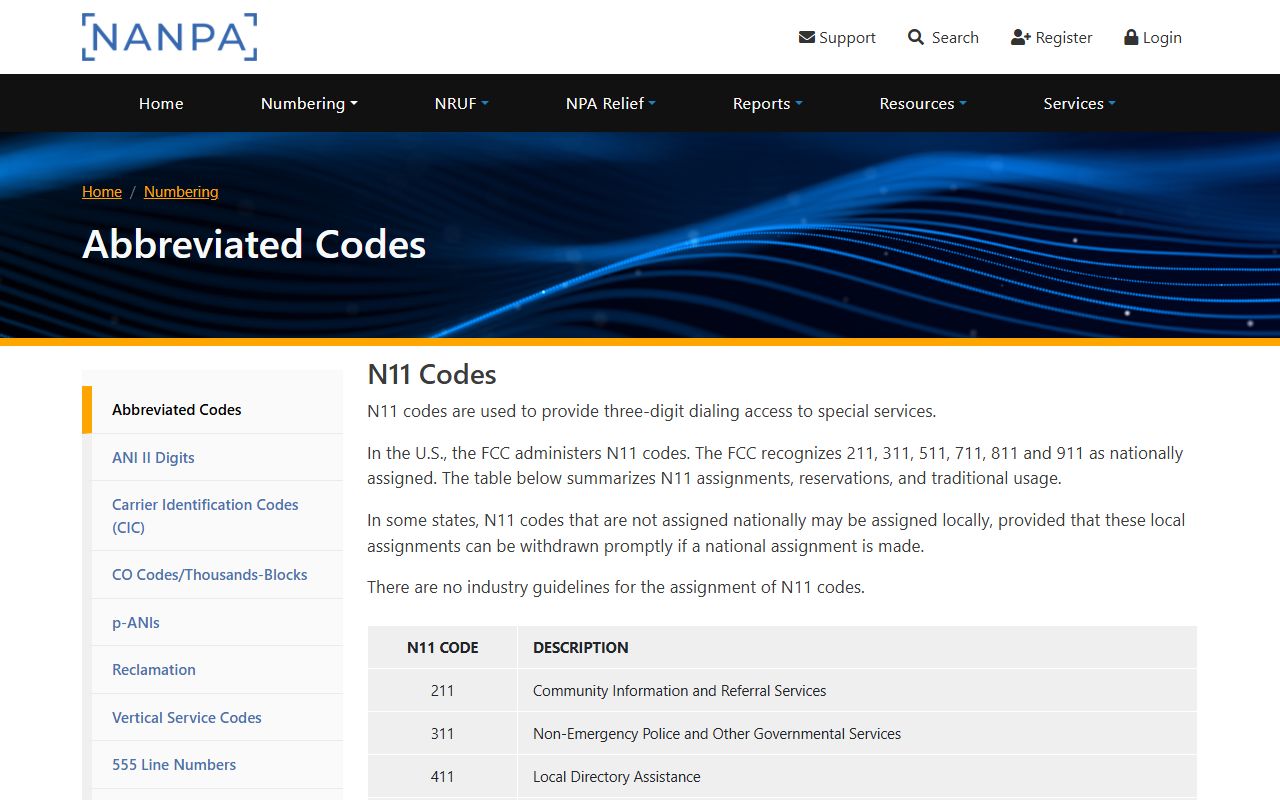
The screenshot supports the N11 and abbreviated-code discussion by tying short dialing codes back to the national numbering authority rather than a generic phone list.