
Guilford County Area Codes List
Guilford County phone area codes are best read as a three-part record: the current primary code, the current overlay, and the historical parent code that no longer serves local Guilford County assignments. Area code 336 is the older local identity code for Greensboro, High Point, Jamestown, Summerfield, Oak Ridge, Stokesdale, Pleasant Garden, Gibsonville-area numbers, McLeansville, Sedalia, and other Triad communities. Area code 743 is the overlay for the same map. It can be assigned to new numbers in the same cities and towns, so a 743 number is not a signal that the caller is outside Greensboro or High Point.
The area code alone also does not prove the caller's current address. Wireless lines, VoIP numbers, business phone systems, and number portability can separate a number from the place where it was first assigned. Still, the area code remains useful for basic screening. A Guilford County area code search should first confirm whether the number belongs to the 336/743 overlay complex, then use the NXX prefix and an official directory when the caller claims to be a county office, city department, school, utility, or court.
| Area Code | Coverage | Year Assigned | Overlay Status |
|---|---|---|---|
| 336 | Greensboro, High Point, Jamestown, Summerfield, Oak Ridge, Stokesdale, Pleasant Garden, Gibsonville-area numbers, and surrounding Guilford County communities | 1997 | Primary local code, now shares the same map with 743 |
| 743 | Same Guilford County and wider 336 territory as 336 | 2016 | Overlay code for new assignments in the same local calling area |
| 910 | Historical parent area for Guilford County before the 336 split | 1993 | Relinquished for Guilford County local service after the 336 split |
Guilford County Area Code Coverage
The important map rule is simple: 336 and 743 cover the same Guilford County territory. There is no Greensboro-only area code and no High Point-only area code. A new business line in downtown Greensboro may receive 743, while a long-held mobile number in High Point may still show 336. Jamestown, Oak Ridge, Summerfield, Stokesdale, Pleasant Garden, Gibsonville-area service, McLeansville, Sedalia, and nearby county communities sit inside the same local numbering environment.
ZIP codes can help a resident describe a place, but they are not proof of a telephone rate center. Guilford County ZIPs commonly tied to Greensboro, High Point, Jamestown, Summerfield, Stokesdale, and Gibsonville-area addresses can all be part of the 336/743 environment, while telephone boundaries are built around rate centers and carrier assignments. That is why a number used by a countywide agency can look like a Greensboro number, and a business serving several towns can keep a High Point rate-center clue.
The NANPA planning letters index is one source for the area-code history behind Guilford County phone area codes.
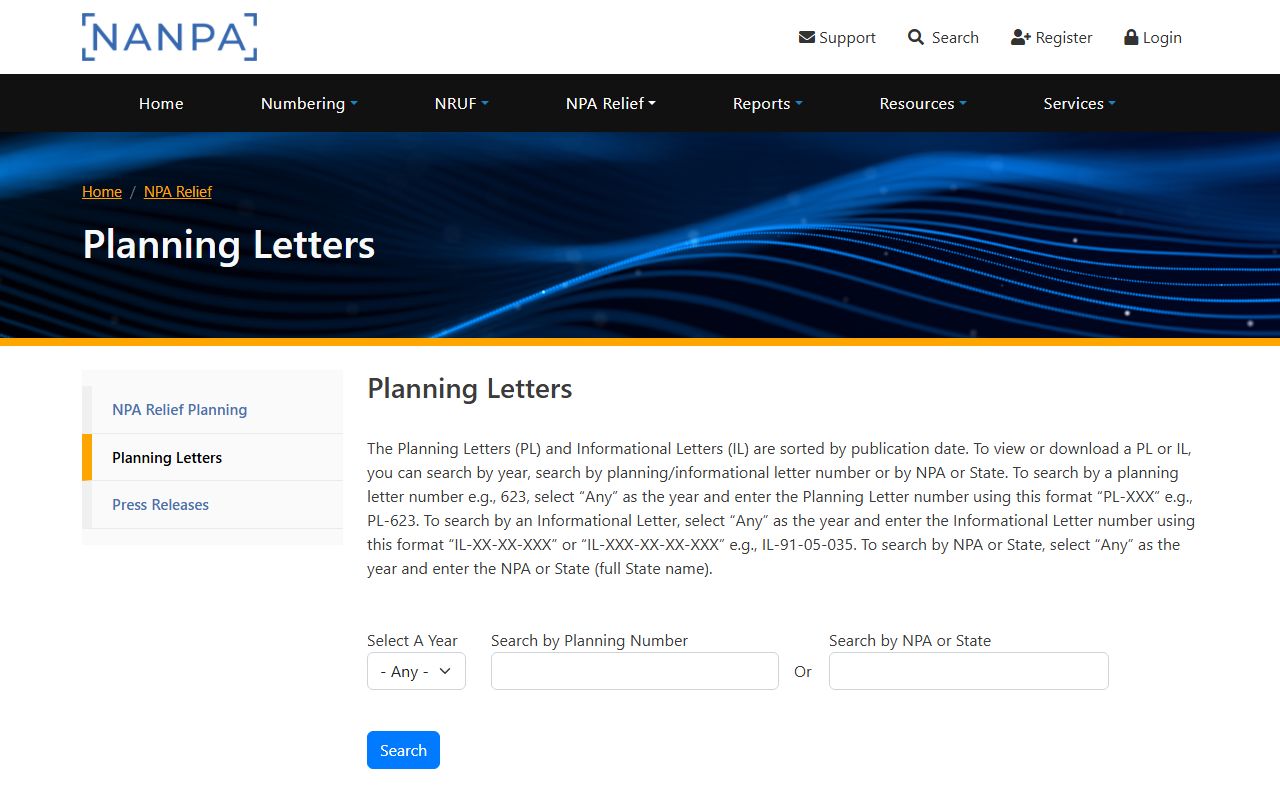
NANPA planning material gives the local area code map a source trail, especially for the split that moved Guilford County out of the old 910 numbering-plan area.
- Greensboro uses 336 and 743 for local assignments, including county, city, campus, business, residential, and wireless numbers.
- High Point uses the same 336/743 overlay, with local telecom history tied to both Bell System and North State service patterns.
- Jamestown and west-central county communities share the same overlay map rather than a separate suburb code.
- Summerfield, Oak Ridge, and Stokesdale sit in the north Guilford County numbering environment served by 336 and 743.
- Pleasant Garden, McLeansville, Sedalia, and Gibsonville-area numbers should be checked by prefix or official directory, not by area code alone.
Note: A Guilford County area code can be spoofed on caller ID, so official callbacks should use agency directory numbers.
Overlay and Split Definitions
Guilford County has experienced both major area-code relief methods. The county entered 336 through a split from 910, which changed the code for the territory placed into the new numbering-plan area. Later, the county received 743 as an overlay on top of 336. That second change did not take existing 336 numbers away from residents or offices. It added new number inventory to the same map and changed the dialing habit for local calls.
- NPA
- The numbering-plan area, better known as the area code. For current Guilford County local numbers, the main NPAs are 336 and 743.
- NXX
- The three-digit prefix after the area code. It can suggest an original rate center or carrier block, but portability can make the clue stale.
- Overlay
- A new area code placed on the same geographic area as an existing code. In Guilford County, 743 overlays 336.
- Split
- A relief method that divides geography between codes. Guilford County moved into 336 when 336 split from 910.
This distinction matters for area code interpretation. A split can make an old printed number wrong after a transition period. An overlay leaves existing numbers in place, but the network needs the area code for every local call because the same seven-digit number may exist under more than one area code. Guilford County's modern rule comes from the overlay, not from a new county boundary.
Guilford County Dialing Rule
Guilford County local calls in the 336/743 overlay area require the area code plus the seven-digit number. Permissive 10-digit dialing began in October 2015, when both the old and new local dialing patterns were accepted during the transition. Mandatory 10-digit local dialing began in April 2016. New 743 numbers became available the next month. Long-distance calls may still require 1 plus the 10-digit number, depending on the carrier and calling plan.
Important: Local Guilford County calls need 10 digits; seven-digit dialing ended when the 743 overlay became mandatory.
The dialing rule does not decide whether a call is local or toll. It only tells the network how much of the number must be dialed. A Greensboro caller phoning a High Point local number may need the full 10 digits even when the call is still local under that person's service plan. For deeper use of N11, star codes, toll-free prefixes, +1, and 011, the Guilford County phone codes reference handles the dialing-code side of the same numbering system.
The North Carolina Public Staff 10-digit dialing release documents the local dialing change for the 336/743 area.
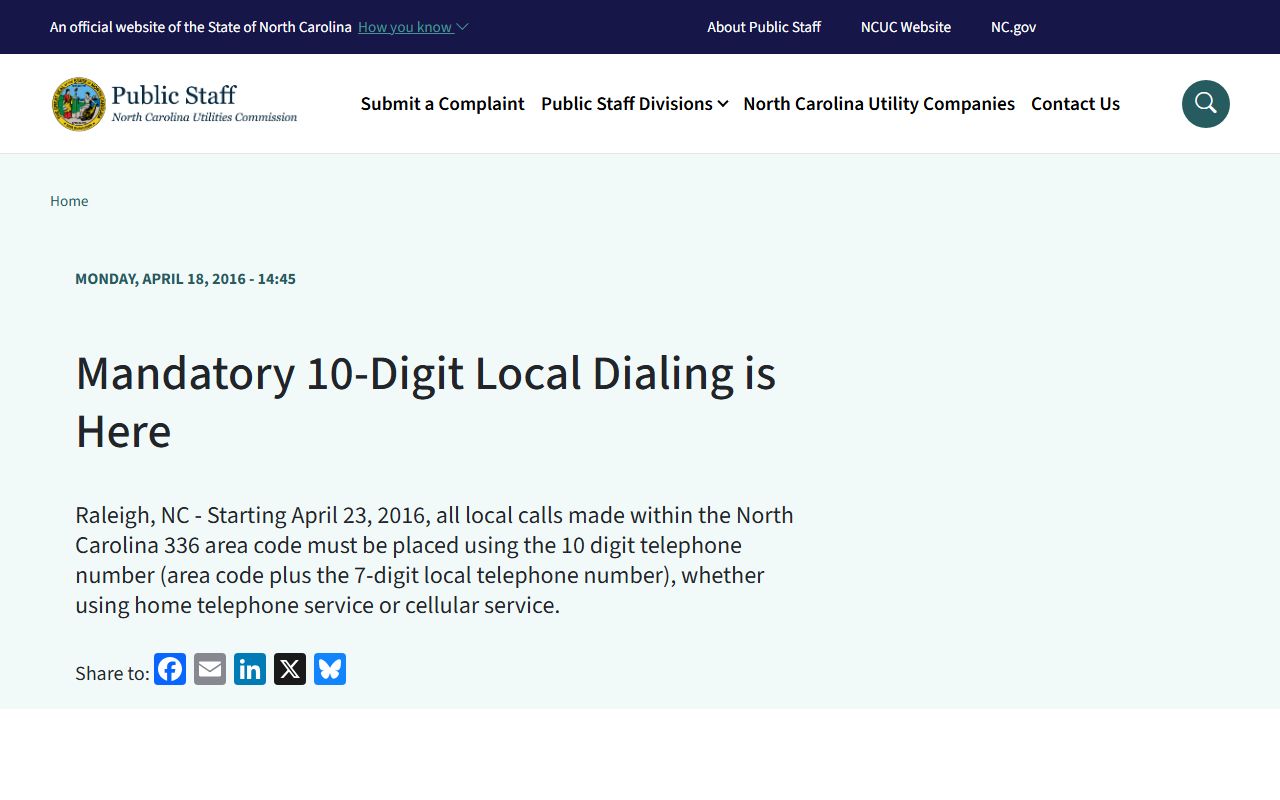
The Public Staff notice is the clearest state-facing reference for why Guilford County residents dial the full local number after the overlay.
Guilford County Area Code Timeline
Guilford County area code history traces a long chain across North Carolina. The state began in the original North American Numbering Plan with 704. Eastern and central North Carolina later moved into 919, and 910 split from 919 before 336 was created from 910. For Guilford County, the key modern event was the 1997 implementation of 336, which gave the Triad the area-code identity still seen across county government, Greensboro services, High Point services, schools, and local businesses.
| Year | Event |
|---|---|
| 1947 | North Carolina was originally covered by area code 704 under the first North American Numbering Plan assignments. |
| 1954 | Area code 919 split from 704 to cover eastern and central North Carolina. |
| 1993 | Area code 910 split from 919, placing Guilford County in the parent area that later gave way to 336. |
| 1997 | Area code 336 split from 910, with NANPA Planning Letter PL-105 setting implementation for December 15, 1997. |
| 2014 | North Carolina regulators approved relief for 336 through the 743 overlay. |
| 2015 | Permissive 10-digit local dialing began in the 336 area. |
| 2016 | Mandatory 10-digit local dialing began, followed by new 743 number assignments. |
| 2025 | NANPA's annual reporting moved the 336/743 exhaust projection to 1Q2065. |
Telephone history in Guilford County is not only an area-code story. NCpedia notes that Greensboro had a telephone exchange in 1889, and Southern Bell bought it in 1903. High Point also has a distinct independent telephone history through North State, whose roots included the purchase of High Point telephone franchise interests from Southern Bell interests around 1919 and early automatic-dial service in North Carolina. Those histories explain why some older local prefix patterns are tied to different legacy service areas even though modern dialing uses the same 336/743 area-code overlay.
Guilford County NXX Prefix Caveats
The NXX prefix is the three digits after the area code. In a number such as 336-641-3383, 336 is the area code and 641 is the prefix. Prefixes once gave a strong clue about the switch, carrier, and rate center behind a number. They are still useful, but they are not a final answer. Local Number Portability allows a user to keep a number after changing carriers. Wireless assignment, VoIP service, number pooling, and business phone platforms can also separate the current line from its original prefix block.
Research examples show Greensboro prefixes such as 336-540, 336-545, and 336-547 under BellSouth or Southern Bell lineage, plus 336-542 and 336-549 wireless examples. High Point examples include 336-823 and 743-256, while 743 examples in Greensboro include blocks tied to Verizon Wireless, Onvoy, MetroPCS, CSC Wireless, North State-related listings, Twilio, and T-Mobile blocks. These examples should be treated as carrier and rate-center clues from numbering data, not as proof of the current user.
For an unknown Guilford County area code and prefix, start with official agency directories when the caller claims to be government, school, hospital, utility, or court. If the caller is private or unclear, an LNP-aware professional lookup can give a more current carrier or line-type signal than a static NPA-NXX table. Even then, spoofing can place a real Guilford County area code on a fraudulent call.
Note: Prefix clues are helpful for pattern recognition, but they should never replace a callback through an official agency directory.
NANPA and State Area Code Sources
Authoritative Guilford County area code checks should use numbering-plan and regulator sources first. NANPA is the core source for area-code planning letters, relief planning, numbering-plan administration, and the historical split that created 336. The FCC area-code consumer reference explains the national structure at a higher level, including why area codes exist and how numbering resources are assigned. North Carolina sources, including the Public Staff and the North Carolina Utilities Commission telecommunications pages, document state-facing relief and dialing information.
The North Carolina Utilities Commission telecommunications page is the state regulator reference connected to telecom oversight and area-code relief context.
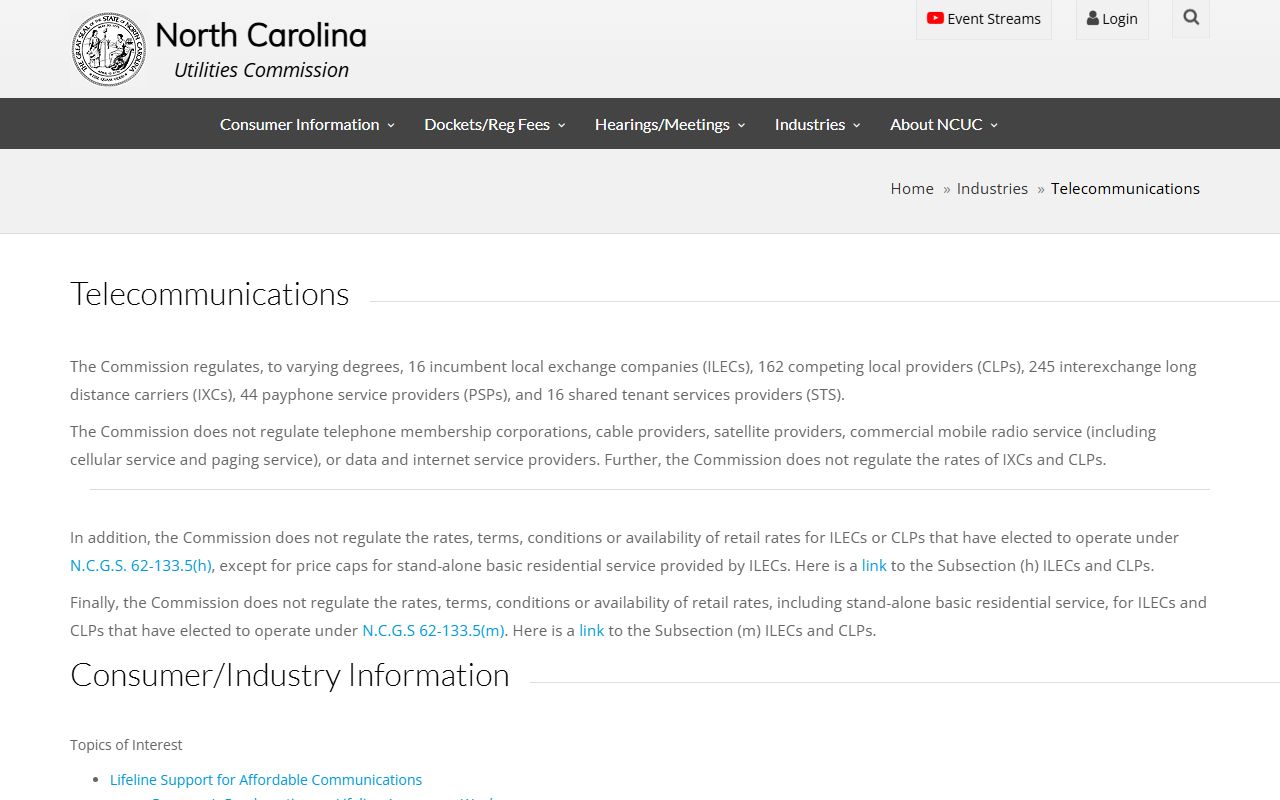
The state regulator source supports the same relief-planning chain used by NANPA and the Public Staff when Guilford County dialing changed.
Future Guilford County Area Codes
No near-term third area code is identified for Guilford County in the cited research. NANPA's 2025 Annual Report moved the 336/743 exhaust projection from 4Q2054 to 1Q2065, which points away from an immediate relief code. That forecast can change as number demand, carrier block assignments, wireless growth, VoIP use, and number conservation measures change. The current source record does not support saying that a new overlay is coming soon.
If relief is needed later, the likely path would follow the same public process used for 743: industry planning, NANPA documentation, state regulatory review, public notice, a permissive dialing window if the dialing pattern changes, and a final mandatory date. Because Guilford County already uses 10-digit dialing, a future overlay would be less disruptive than the 336 split from 910. Existing numbers would normally stay in place, while new inventory would be assigned under the new code after approval.
Note: Future area-code projections are planning estimates, so local businesses should check current NANPA and state notices before printing long-lived materials.